The Secret Key to Heaven
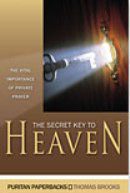
The Secret Key to Heaven
Additional information
| Review | |
|---|---|
| Series | |
| ISBN 13 | |
| Reference | |
| ISBN 10 | |
| Author | |
| Type | |
| Publisher |
Additional information
| Review | |
|---|---|
| Series | |
| ISBN 13 | |
| Reference | |
| ISBN 10 | |
| Author | |
| Type | |
| Publisher |
Additional information
| Review | |
|---|---|
| Series | |
| ISBN 13 | |
| Reference | |
| ISBN 10 | |
| Author | |
| Type | |
| Publisher |
Additional information
| Review | |
|---|---|
| Series | |
| ISBN 13 | |
| Reference | |
| ISBN 10 | |
| Author | |
| Type | |
| Publisher |
Category
Additional information
| Review | |
|---|---|
| Series | |
| ISBN 13 | |
| Reference | |
| ISBN 10 | |
| Author | |
| Type | |
| Publisher |
‘The power of religion and godliness lives, thrives, or dies, as closet prayer lives, thrives, or dies.’ This was the deeply held conviction of Thomas Brooks, the author of this book. As a pastor who knew his people well, he feared that many Christians do not understand the necessity, excellency, and usefulness of private prayer, and that many live ‘too great a neglect of this indispensable duty.’ Focussing on our Lord’s words about ‘closet-prayer’ in Matthew 6:6, Brooks gives us a masterful treatment of a vitally important aspect of Christian’s living. His aim is intensely practical, ‘to preserve and keep up the power of religion and godliness both in men’s houses, hearts, and lives.’
£6.25
Share
Reviews
It is a long time since we read such a profitable book as The Secret Key to Heaven – howbeit it comes with a gentle reproof for our spiritual slothfulness and indolence.
The subject is the vital necessity in the Christian life for secret prayer. (“Closet prayer” is the term the author uses throughout, as his discourse is based on Matthew 6. 6: “But thou, when thou prayest, enter into thy closet, and when thou hast shut thy door, pray to thy Father which is in secret; and thy Father which seeth in secret shall reward thee openly.”) So the sub-title is “The Vital Importance of Private Prayer.” Right at the beginning, in the preface, the author states: “The power of religion and godliness lives, thrives or dies, as closet prayer lives, thrives or dies. Godliness never rises to a higher pitch than when men keep closest to their closets.” He continues:
“Every man is that really which he is secretly. Never tell me how handsomely, how purely, how bravely, this or that man acts his part before others but tell me, if you can, how he acts his part before God in his closet; for the man is that certainly that he is secretly.”
Thomas Brooks would strongly have disagreed with the commonly repeated saying: “The prayer meeting is the barometer (or thermometer) of the church.” “No,” he would have emphatically replied, “secret prayer!”
This book, fist published at the time of the great plague in 1665, is written in true Puritan style but Thomas Brooks (1608-1680) has been called “the most readable of the Puritans.” So this would be a good introduction for any who have heard of the Puritans’ works but are rather fearful about venturing to read them. There is nothing difficult or complicated here but plain, simple, gracious writing. People today may smile at the Puritans saying “nineteenthly” and “twentiethly” (as Brooks does) but this is to keep his points separate and make them clear.
The only section of the book which to us seems dated is the short section dealing with the problem that household servants and maids may have in finding time and also a private place for prayer. But even this shows the pastoral sympathy and care of the author – as in the seventeenth century there were many in this position.
Interestingly, Brooks at the outset states that he had never heard a sermon on the subject and had never come across a book written on the subject. Speaking to old, godly men and women, they said the same.
Thomas Brooks, as well as speaking of the great value of private prayer, deals with the difficulties that people have: wandering thoughts; the temptations of Satan; lack of ability in prayer; weakness and infirmity – and also Satan’s constant thrust: if God knows all your desire, if He will accomplish His purposes and do what is best, then why pray? The point is made very clear: we must not trust in our private prayers, or think there is anything meritorious in them. Our trust and our only plea must be Christ.
The book is enriched by numerous illustrations and by many short, apt, pithy sayings. These latter are so profitable that we have included some of them separately – not merely as an insight into The Secret Key to Heaven but because they are so helpful.
We feel it would be a good thing if every professed believer in our chapels were to read The Secret Key to Heaven. We are left with a solemn sense of the vital importance of all that Brooks says and a sense of our own failures in secret prayer. We have to look to the Holy Spirit for His divine enabling.
B A Ramsbottom
The Gospel Standard
June 2006